


This page is translated with help of Google
Translate (English text ) )
Cette page est traduite avec l'aide de Google Translate
LE SYSTÈME RESARO
Donne des solutions pour
certains des problèmes de construction les plus courantes
aujourd'hui.
Ce texte contient
des titres suivants
(appuyez surpour un mouvement
rapide de la page)
POURQUOI UTILISER LE SYSTÈME RESARO?
Complications à des constructions d'aujourd'hui
Maisons informatisés
Perte d'énergie et les problèmes lors de l'utilisation
d'une fonte de la dalle sur le sol pour le chauffage au sol
Problèmes lors de l'utilisation d'évacuation d'air
ventilé sanitaires fondations de l'espace dans les solutions
classiques
Le risque de condensation dans l'air ventilé échappement
chauds fondations de l'espace d'analyse
Radon
Problèmes causés par l'humidité et la moisissure
Problèmes de maisons ventilés naturelles
Moule à cadre causée par imprègne l'air
La capacité de ventilation insuffisante, à la saison
chaude
Moule dans les conduits des installations de chauffage de l'air
Moule derrière les armoires de cuisine
Moule en murs extérieurs de salle de bains
Admission dynamique d'air frais
Problèmes avec les systèmes de ventilation dynamique
commune dans les maisons à deux étages
Solutions complexes pour la circulation des systèmes de
chauffage à air chaud à 1 1/2- maisons à
étages et deux étages
Problèmes au deuxième étage ventilation
Problèmes avec des échangeurs de chaleur de récupération
de chaleur
Aucun bénéfice de l'aide d'une pompe à chaleur
air d'échappement
Itinéraire se trouvent au bas de cette page
POURQUOI UTILISER LE SYSTÈME
DE RESARO?
Un bref résumé de graves problèmes apparaissant
fréquemment à des constructions d'aujourd'hui qui
évite au système RESARO.
Maisons informatisés
- La tendance de la construction d'aujourd'hui est à des
systèmes plus compliqués et complexes pour le chauffage
et la ventilation. Il semble que certaines chambres dans des
maisons met de côté pour les systèmes de
surveillance informatisés.
la solution
avec le système RESARO
- Toute la technologie informatique est possible
de le remplacer par un système simple, qui fonctionne
d'une manière simple et fiable, avec l'aide de flux d'air
naturel.
A titre d'exemple, dans le système RESARO les commandes
d'approvisionnement en énergie par un régulateur
de température simple, placés au centre de la résidence.
Le problème
Perte d'énergie au chauffage par le sol
-
Les acheteurs de maison d'aujourd'hui ou «auto-constructeurs»
souhaite avoir le chauffage au sol. Les systèmes disponibles
sur le marché sont coûteux, cependant. Avec les
systèmes et les tubes ou tuyaux avec de l'eau circulant
réflecteur.
Autres jette dans la dalle qui est généralement
placé directement sur le sol.
Une dalle de béton sur un sol chaud
entraîne des pertes d'énergie graves vers le bas
le sol et coulé dans des installations sont inaccessibles
et doivent être mis à nu par forage moteur de marteau
à la fuite.
Dans les systèmes existants pour le
chauffage au sol, la température de l'eau n'a pas à
être en dessous de 28 degrés Celsius, lorsque la
température extérieure est basse, voyant que toute
la chaleur est transférée via les planchers dans
les chambres.
Une conception commune et par les autorités
de construction modification recommandée.
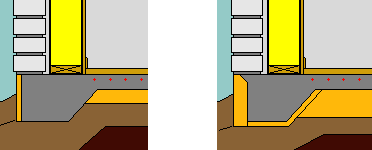
COMMON DESIGN AND RECOMMENDED
MODIFICATION
La solution
avec le système RESARO
Lors de l'utilisation de la conception de la fondation RESARO
et les murs en béton RESARO, il n'y a pas de composants
conducteurs de chaleur en contact avec le sol en dessous, ou
le climat extérieur.
La dalle portante paroi de béton est
recouverte d'une couche continue d'isolation thermique d'épaisseur
égale.
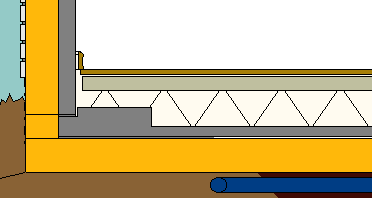
LA SOLUTION DE RESARO
Pas de ponts thermiques
La dalle de plancher repose sur une couche
d'isolation thermique d'une épaisseur de 200 mm.
Les murs extérieurs à son tour repose sur l'élément
de plancher RESARO. L'isolation thermique des parois entourant
les bords de l'élément de plancher.
Par conséquent, il n'y a pas de ponts thermiques.
Le système RESARO:
un système à basse température
Dans les systèmes existants, chauffage au sol signifier
étages avec des températures élevées
et des zones chaudes.
Dans le système RESARO nous parlons d'une température
de surface de 20 à 23 degrés Celsius, "chaleur
douce", étaler sur toute la surface.
Avec des éléments de RESARO
à l'étage inférieur, l'air intérieur
filtré, mélangé à l'air frais de
l'extérieur, circule à travers le double plancher
structurel.
L'air mis en circulation présente une température
légèrement supérieure à la température
intérieure, mais loin de la plus élevée
que dans les bobines de chaleur dans les systèmes classiques.
- Ceci parce que la surface du plancher obtient
environ 50% de sa chaleur de l'air d'alimentation qui circule
à travers les planchers porteurs doubles.
La surface de plancher, à son tour chauffe les pièces
uniformément par rayonnement et convection (conduction
thermique).
L'autre 50% reste avec l'air d'alimentation qui est transféré
à la zone résidentielle, circule derrière
les plinthes de sol et les mélanges et chauffe l'air intérieur.
Pour cette raison, la température de l'air d'alimentation,
dans le système RESARO, peut être conservé
beaucoup plus faible à l'intérieur des éléments
qu'à classique dans les systèmes de chauffage par
le sol, où toute l'énergie est transférée
à travers la dalle de plancher.
- Nous obtenons moins les pertes d'énergie
au sol malgré le système Resaro détient
sols chauds au rez de chaussée.
- Nous température obtLower sur la surface
du sol donne une meilleure atmosphère intérieure.
Parquet rustique et du parquet sont sensibles à des températures
supérieures à 25 degrés Celsius.
Retour à la liste des rubriques
Problèmes
avec échappement chauds ventilé sous-sols de l'espace
d'analyse dans les conceptions classiques.
Une façon courante de récupérer l'énergie
de l'air d'échappement est en le transférant les
bases de vide sanitaire et de là dans une pompe à
chaleur.
La fondation doit avoir une pression plus
basse que les chambres pour éviter l'humidité du
sol pour s'infiltrer dans l'espace de vie.
Difficile d'obtenir
étanche à l'air
En pratique, ces systèmes ne fonctionnent pas bien, comme
le sous-sol est difficile d'obtenir suffisamment étanche
à l'extérieur de l'environnement.
L'air d'échappement est aspiré
vers le bas dans la fondation avec l'aide d'un vide que le ventilateur
d'évacuation d'air crée.
Par conséquent, la fondation maintient une pression qui
est nettement inférieur à l'environnement de.
Les fuites d'air extérieur dans le vide sanitaire en dessous
des poutres de rive. Le résultat est en hiver l'air d'échappement
est mélangé avec l'air extérieur froid qui
ruine la récupération de chaleur.
En outre, un sous-sol aéré de
l'air d'échappement est un système passif, qui
donne seulement le résultat d'une maison avec étages
"moins froid". Avec une température plus basse
que l'air intérieur.
Moins froid que par exemple une dalle sur
le sol, mais pas aussi chaud ou chauffé au chauffage par
le sol.
Risque de condensation
dans les sous-sols de l'air ventilé échappement:
La température de l'air dans un sous-sol aéré
d'évacuation d'air est plus frais que l'air intérieur
parce que le sol se refroidit en dessous.
L'air d'échappement qui provient des locaux humides de
la maison contient une grande quantité d'eau, c'est-à-dire
que c'est l'humidité relative est élevée.
Au refroidissement il ya un risque de condensation,
pourquoi il ya un grand risque pour une construction de plancher,
composé de bois ou d'autres matières organiques
qui fait face au sol, d'être touchés par la pourriture
ou de moisissure.
La solution
avec le système RESARO
- Dans l'air circule chauffées du système
RESARO l'intérieur de la structure de plancher bas donc
les dommages causés par l'humidité est efficacement
empêché.
Problems
with radon from the ground
- A cast slab directly on the ground is not an efficient protection
from radon, even if it is very thick. In most cases no protection
at all, as concrete always cracks.
Up-to-date houses have, nearly always, a vacuum inside, why radon
gas easily finds it's way up and inside the dwelling through
the cracks.
La solution
avec le système RESARO
- Le système RESARO fournir un abri
efficace contre le radon venant du sol.
Avec la solution de système RESARO SUR PRESSION FOUNDATION,
le gaz radon disparaît sous une bâche, ce qui rend
le fond de la maison.
- Lorsque la terre avec un niveau élevé
de radon, un fort partout bâche soudée sera utilisé.
Afin de garantir le radon de pénétrer dans le logement,
la bâche est rendue plus grande que la fondation et atteint
sur les bords.
- L'intérieur de la structure de plancher
RESARO, en l'espace de circulation, nous pouvons trouver une
légère surpression, ce qui gêne également
le radon de pénétrer dans la maison si les fissures
de la dalle de fond.
Retour à la liste des rubriques
Problèmes
avec de l'humidité et de la moisissure
L'humidité de la
construction
- Un des plus grands problèmes est soi-disant «maisons
malades» où la moisissure apparaît.
L'humidité et la ventilation insuffisante avec des matières
gênant choisi combinée avec un béton et cadre
mal séché sont dans la plupart des cas, la raison.
Par exemple, l'humidité dans les constructions
en béton lourds où le revêtement de surface
a été mis sur trop tôt, peut-être au-dessus
de mastic qui est parfois faite d'un matériau organique.
En conséquence, les réactions chimiques qui exhalent
des gaz d'empoisonnement apparaît, avec beaucoup de désagréments
pour les résidents.
Moule et les dommages causés par l'humidité
dans les murs extérieurs derrière douche et baignoire
sont également des problèmes communs.
La solution
avec le système RESARO
- Le risque pour les formations de moisissures
dans élimine cadres.
Lorsque vous utilisez le système RESARO les étages
structurels établit un moyen de canal de distribution
pour l'air chauffé circulation de l'offre et de l'air
d'alimentation de ventilation.
Pendant ce temps le cadre s'assèche.
- Même si les sols structurels RESARO
ne servent pas comme un conduit d'alimentation d'air par exemple
dans les maisons de département, pendant le temps de montage
d'une circulation d'air simple peut être disposé
à l'intérieur des éléments RESARO,
pour le séchage.
Éventuellement avec l'aide d'un sèche-construction.
- Le revêtement de surface peut être
appliqué à un stade plus précoce que les
autres systèmes.
Problèmes
les maisons ventilés naturelles
Moule à cadre causés
par les fuites d'air
Si la maison n'a pas d'unité de ventilateur d'extraction
d'air qui crée un vide, mais une ventilation tout à
fait naturel, une légère surpression ouvrira en
dernier étage.
L'air chaud et humide à l'intérieur
pénètre, à petites ouvertures, à
travers les murs extérieurs et le plafond et émet
son humidité dans l'isolation thermique et le cadre causant
des dommages en bois.
Lieux où la
maison montre les dégâts sont marqués avec
des anneaux
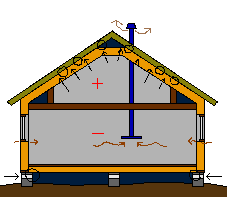

La solution
avec le système RESARO
- Dans le système RESARO nous utilisons
toujours une unité de ventilateur d'évacuation
d'air qui crée un léger vide dans la maison.
- RESARO AB a une demande de brevet pour les
arrangements pour empêcher l'air de pénétrer
à l'intérieur de l'isolation thermique lors de
l'utilisation d'admission dynamique d'air frais.
Voir également le paragraphe ci-dessous "admission
dynamique d'air frais".
Problèmes
avec un mauvais effet de la ventilation des saisons chaudes
Dans les maisons ventilés naturelles
de la ventilation n'a aucun effet pendant les saisons chaudes
que la qualification pour créer les divergences de densité
- chaudes et froides - qui compose la puissance des mouvements
de l'air, sont absents.
Avec des matériaux de construction
humides qui a été stocké à l'extérieur,
ou si il a plu sur le cadre, peut-être même sur l'isolation
thermique, avant l'abri du toit a été mis en place,
il ya de grands risques pour la formation de moisissures d'apparaître.
Dans une maison, une fois endommagé
par la moisissure ou de pourriture, l'odeur et l'influence du
poison reste à jamais.
La solution
avec le système RESARO
- Dans le système RESARO une unité
de ventilateur d'évacuation d'air est utilisé,
il est donc toujours un léger vide dans les chambres et
l'air de ventilation est suffisante à toutes les saisons.
Voir également le paragraphe ci-dessous "admission
dynamique d'air frais".
Retour à la liste des rubriques
Problèmes
avec de la moisissure dans les conduits dans les installations
de chauffage à air chaud
- Une raison plausible pour le moule à comparaître,
est placements inopportuns de conduits pour le chauffage de l'air
à l'intérieur de l'isolation thermique dans le
plafond.
Les conduits doivent être placés
au-dessus des fermes de toit membrures inférieures, ce
qui signifie, plus proche de l'air extérieur en hiver
froid.
La chaleur dégagée par les conduits se lève
et donne son énergie à l'air
Une raison plausible de
ces maisons nécessite beaucoup d'énergie!
Les conduits passe par les parties froides
du grenier. L'air intérieur chaud qui contient une quantité
considérable d'humidité, passe à travers
les conduits et se refroidit de.
Pour cela, le risque que la température
descendre en dessous du point de rosée est grave, entraînant
l'humidité sur les parois des conduits.
S'il existe à la fois à la poussière
se trouvent dans les conduits les possibilités de moule
à apparaître.
La solution
avec le système RESARO
- Le risque pour le moule à apparaître
dans les conduits d'air est complètement éliminé.
La solution simple
avec le système RESARO est de toujours nourrir l'air d'alimentation
chauffée par le dessous, toujours dans des espaces chaleureux
et toujours à l'intérieur.
problèmes
avec de la moisissure / moisissure derrière les armoires
de cuisine
- Un lieu où la moisissure apparaît souvent est
derrière les armoires de cuisine à parois extérieures.
Ceci parce que les placards surtout sont entassés avec
des ustensiles de cuisine et des articles alimentaires qui fonctionne
comme un isolant thermique.
Une mauvaise ventilation derrière les
armoires de cuisine et un sol froid, par exemple, une dalle coulée
directement sur le sol, ou un étage au-dessus d'un air
frais ventilé sous-sol du vide sanitaire, crée
les conditions nécessaires pour le moule.
L'humidité, la nourriture et l'oxygène,
La solution
avec le système RESARO
- Lorsque vous utilisez le système RESARO
l'air chaud de ventilation est dirigé derrière
les armoires de cuisine sur les parois extérieures.
L'air passe derrière les placards, à travers les
évidements de placard pour les plinthes, puis dans la
chambre.
Surtout, il passe également le lave-vaisselle.
Problèmes
avec de la moisissure à l'intérieur d'une paroi
extérieure dans une douche
- En tenant compte de l'espace, d'une douche est souvent placé
à côté d'une paroi extérieure. Même
si un isolement de la membrane très épaisse est
placée derrière le revêtement de surface
à l'intérieur de la douche, l'humidité pénètre
toujours la membrane en raison de pressions de vapeur.
Les surfaces froides attirent toujours l'humidité.
Il ya toujours un risque pour le moule à
apparaître.
L'accumulation d'humidité augmente
le risque de panneaux muraux à gonfler puis casser les
tuiles vernissées.
La solution
avec le système RESARO
- Une cavité derrière la plaque
de plâtre dans la paroi extérieure de l'air intérieur
en circulation, guidé sur un niveau avec le plafond du
local humide, présente une butée efficace pour
que l'humidité se déplaçant vers la paroi
extérieure de froid.
Le système RESARO
donne l'occasion de placer une douche à côté
d'un mur extérieur sans risque de condensation à
l'intérieur du mur.
Retour à la liste des rubriques
Admission
dynamique d'air frais
Problèmes
avec les systèmes existants en utilisant la technique
d'isolation dynamique pour la ventilation.
(La conception du système RESARO est désigné
«l'apport d'air frais dynamique")
Problems
with two-storey houses with dynamic insulation.
En hiver, dans des maisons à deux étages de l'air
chaud à l'intérieur crée une surpression
dans les parties supérieures de la maison, en raison de
la diversité de la densité (l'air chaud est plus
léger que cool).
Par conséquent, l'air intérieur fait son chemin
vers le haut.
(Comparer la ventilation naturelle avec
le projet de la densité de l'auto)
La solution
avec le système RESARO dans des maisons à deux
étages:
- Dans le système RESARO le toit est
meublée avec un plafond supplémentaire à
l'intérieur d'isolation thermique de la toiture, la création
d'un compartiment entre l'isolant et les panneaux de plafond
supplémentaires.
- Un pare-vapeur placé au-dessus des
panneaux de plafond empêche l'air de pénétrer
à l'intérieur de l'isolation, et causer des dommages.
Une construction approuvé brevet donne une distribution
uniforme de l'air d'entrée sur toute la surface de l'isolant.
Une boîte de collection transfère l'air frais dans
le système de circulation à l'intérieur.
Cette disposition permet de s'assurer que l'air intérieur
humide ne va pas le "mauvais sens" vers l'isolation
thermique.
- A travers la procédure ci-dessus pour
laisser l'air de circulation transférer l'air de ventilation
dans les chambres, il évite également l'air intérieur
pour entrer en contact avec l'isolant cool.
Problèmes
Solutions complexes pour la circulation des systèmes de
chauffage à air chaud à 1 1/2- maisons à
étages et deux étages
- Les systèmes de chauffage à air chaud classiques,
dans un 1 1/2-floors- ou une maison à deux étages,
sont très complexes avec de nombreux canaux.
Conduits de distribution, pour le chauffage
et la ventilation du rez de chaussée et offre des conduits
qui mène à et sont installés à l'intérieur
de l'isolation thermique de la toiture pour la ventilation de
l'étage supérieur, sont souvent placés sous
le plancher intermédiaire dans les conduits d'acier horizontales
qui change alors de direction, allant vers le haut.
Couverte par des plafonds immergés, à l'intérieur
des chambres.
Opérations de travail: Les conduits
doivent être pendus, couverte par des lattes de bois et
plaques de plâtre. Il après masticage et peinture.
La solution
avec le système RESARO
- Avec le système RESARO l'air de la
chaleur et de ventilation est fournie par l'intermédiaire
des étages de structure qui sont un peu plus sous pression.
L'air s'écoule lentement derrière les plinthes
de sol le long des murs extérieurs et suite à un
conduit de retour placé en position centrale menant à
une unité de chaleur pour la trempe et le filtrage.
L'air extérieur frais est ajouté dans le conduit
de retour.
Problèmes
avec ventilation de dernier étage
- Un moyen classique pour guider l'air à l'étage
supérieur est d'utiliser des conduits d'air allant entrées
d'air résiduelles (= trous) dans le sol ou dans le mur.
Pour des raisons techniques, un afflux concentré
apparaît qui donne une mauvaise conversion de l'air de
ventilation.
Une autre procédure consiste à
utiliser une plinthe creuse pour distribuer l'air d'alimentation
le long d'un mur dans une pièce.
Mais plinthes creuses sont chers, apparaît souvent inesthétiques
et entrave l'ameublement.
La solution
avec le système RESARO
- En utilisant le système de RESARO
vous pouvez ventiler l'étage supérieur avec le
même système que pour le rez de chaussée.
- Le système Resaro montre une toute
nouvelle façon de transférer l'air d'alimentation,
le long des plinthes, dans un haut plancher de la salle de pignon.
On obtient ainsi une cavité creux placé dans la
première paroi étages de fin (ou un mur à
proximité). Cette cavité relie l'espace de circulation
à l'intérieur du plancher structural inférieur
avec la pièce de pignon.
- Cette procédure donne une entrée
riche, ce qui donne une conversion efficace de l'air de ventilation
dans la pièce entière.
- Nous avons l'avantage de chambres sans radiateurs
et les plinthes en creux peu attrayants et pratique pour meubler
et propre.
Retour à la liste des rubriques
Problèmes
avec des échangeurs de chaleur pour la récupération
de chaleur.
- Un problème pas connu avec des échangeurs de
chaleur, c'est qu'ils doivent être nettoyés au moins
une fois par an.
Lorsque l'air d'échappement chaud et
humide en provenance de locaux humides remplissent les échangeurs
de chaleur des surfaces froides, rafraîchis par l'air extérieur
hiver tempéré, de la condensation apparaît
toujours.
Lorsque de la poussière dans l'air
d'échappement, les conditions nécessaires pour
le moule crée dans les échangeurs et les spores
de moisissure accompagne l'air extérieur dans les chambres.
Cela peut être
une des raisons pourquoi les gens développent des allergies.
La solution:
Le système RESARO sans unité de récupération
- Grâce à la solution complète
du système RESARO dans une maison standard isolé,
il n'y a pas d'unités de récupération nécessaires
pour régler les revendications des codes du bâtiment.
Dans une maison isolée
avec la norme......
- inférieurs température intérieure
grâce à étages chauds
- récupération d'énergie
avec la conception de l'apport d'air frais par l'isolation thermique
des toits où la chaleur est transférée dans
la maison
- the arrangement with the "over pressure
foundation" where the bottom parts of the house heats by
the exhaust air.....
.......il n'y a pas
besoin d'une unité de récupération de chaleur.
- A la saison froide l'apport d'air frais passe
par l'isolation thermique des toits et conduit l'air chaud de
retour à nouveau, donc l'isolation peut être faite
beaucoup plus mince qu'à une application classique, sans
perdre son effet.
- Le fait est que l'épaisseur de l'isolation
des toits est réglée sur les besoins pour fournir
la maison de la chaleur par le haut, à la saison chaude.
Problèmes
Aucun bénéfice de l'aide d'une pompe à chaleur
air d'échappement
- Échappement des pompes à chaleur de l'air sont
coûteux à acheter et à installer.
Il s'est avéré que la durée de vie de ses
parties vitales n'est plus que d'environ 8 ans, pourquoi les
coûts de services vient généralement à
un montant supérieur à l'épargne.
La
solution
avec le système RESARO
- Lors de l'utilisation de la solution de système
complet RESARO il n'est pas nécessaire pour les unités
de récupération de chaleur pour une maison isolée
standard.
- Cependant, le système fonctionne RESARO
excellente avec une pompe à chaleur d'air d'échappement.
Mais avec l'énergie d'aujourd'hui coûte les frais
pour l'achat et l'installation d'une pompe à chaleur air
d'échappement "ne pas rembourser" avec ce système.
- Lorsque les coûts d'énergie
plus élevée du système de RESARO serait
excellent pour terminer avec une pompe à chaleur d'air
d'échappement.
Sont donc nos installations aujourd'hui toujours préparés
pour une future connexion avec une pompe à chaleur de
l'air évacué.
Retour à la liste des rubriques
LES ANNEXES DE TEXTE
Le système de RESARO pour des maisons d'habitation;Des
informations pour des ACHETEURS
Information court sur le système d'entrée d'air
dynamique
to LE SYSTÈME RESARO PAGE
to LA PAGE RESARO TECHNOLOGIE
to LA PAGE D'ACCUEIL RESARO
|